|
 https://arxiv.org/abs/1612.08242 https://arxiv.org/abs/1612.08242 |
|---|
A yolo windows version (for object detection)
Contributtors: https://github.com/pjreddie/darknet/graphs/contributors
This repository is forked from Linux-version: https://github.com/pjreddie/darknet
More details: http://pjreddie.com/darknet/yolo/
yolo.cfg (256 MB COCO-model) - require 4 GB GPU-RAM: http://pjreddie.com/media/files/yolo.weightsyolo-voc.cfg (256 MB VOC-model) - require 4 GB GPU-RAM: http://pjreddie.com/media/files/yolo-voc.weightstiny-yolo.cfg (60 MB COCO-model) - require 1 GB GPU-RAM: http://pjreddie.com/media/files/tiny-yolo.weightstiny-yolo-voc.cfg (60 MB VOC-model) - require 1 GB GPU-RAM: http://pjreddie.com/media/files/tiny-yolo-voc.weightsPut it near compiled: darknet.exe
You can get cfg-files by path: darknet/cfg/
Others: https://www.youtube.com/channel/UC7ev3hNVkx4DzZ3LO19oebg
build\darknet\x64\:darknet_voc.cmd - initialization with 256 MB VOC-model yolo-voc.weights & yolo-voc.cfg and waiting for entering the name of the image filedarknet_demo_voc.cmd - initialization with 256 MB VOC-model yolo-voc.weights & yolo-voc.cfg and play your video file which you must rename to: test.mp4, and store result to: test_dnn_out.avidarknet_net_cam_voc.cmd - initialization with 256 MB VOC-model, play video from network video-camera mjpeg-stream (also from you phone) and store result to: test_dnn_out.avidarknet_web_cam_voc.cmd - initialization with 256 MB VOC-model, play video from Web-Camera number #0 and store result to: test_dnn_out.avidarknet.exe detector test data/coco.data yolo.cfg yolo.weights -i 0 -thresh 0.2darknet.exe detect yolo.cfg yolo.weights -i 0 -thresh 0.2darknet.exe detector test data/voc.data yolo-voc.cfg yolo-voc.weights -i 0darknet.exe detector demo data/coco.data yolo.cfg yolo.weights test.mp4 -i 0darknet.exe detector demo data/voc.data yolo-voc.cfg yolo-voc.weights test.mp4 -i 0darknet.exe yolo demo yolo-voc.cfg yolo-voc.weights test.mp4 -i 0darknet.exe detector demo data/voc.data tiny-yolo-voc.cfg tiny-yolo-voc.weights test.mp4 -i 0darknet.exe detector demo data/coco.data yolo.cfg yolo.weights http://192.168.0.80:8080/video?dummy=param.mjpg -i 0darknet.exe detector demo data/voc.data yolo-voc.cfg yolo-voc.weights http://192.168.0.80:8080/video?dummy=param.mjpg -i 0darknet.exe detector demo data/voc.data yolo-voc.cfg yolo-voc.weights -c 0Smart WebCam - preferably: https://play.google.com/store/apps/details?id=com.acontech.android.SmartWebCam
IP Webcam: https://play.google.com/store/apps/details?id=com.pas.webcam
darknet.exe detector demo data/coco.data yolo.cfg yolo.weights http://192.168.0.80:8080/video?dummy=param.mjpg -i 0darknet.exe detector demo data/voc.data yolo-voc.cfg yolo-voc.weights http://192.168.0.80:8080/video?dummy=param.mjpg -i 0C:\opencv_2.4.9\opencv\build\include & C:\opencv_2.4.9\opencv\build\x64\vc14\lib), then start MSVS, open build\darknet\darknet.sln, set x64 and Release, and do the: Build -> Build darknet1.1 If you want to build with CUDNN to speed up, then:
* download and install CUDNN: https://developer.nvidia.com/cudnn

* add Windows system variable `cudnn` with path to CUDNN: https://hsto.org/files/a49/3dc/fc4/a493dcfc4bd34a1295fd15e0e2e01f26.jpg

* open `\darknet.sln` -> (right click on project) -> properties  -> C/C++ -> Preprocessor -> Preprocessor Definitions, and add at the beginning of line: `CUDNN;`
If you have other version of CUDA (not 8.0) then open build\darknet\darknet.vcxproj by using Notepad, find 2 places with "CUDA 8.0" and change it to your CUDA-version, then do step 1
If you have other version of OpenCV 2.4.x (not 2.4.9) then you should change pathes after \darknet.sln is opened
3.1 (right click on project) -> properties -> C/C++ -> General -> Additional Include Directories
3.2 (right click on project) -> properties -> Linker -> General -> Additional Library Directories
3.3 Open file: \src\yolo.c and change 3 lines to your OpenCV-version - 249 (for 2.4.9), 2413 (for 2.4.13), ... :
* `#pragma comment(lib, "opencv_core249.lib")`
* `#pragma comment(lib, "opencv_imgproc249.lib")`
* `#pragma comment(lib, "opencv_highgui249.lib")`
Also, you can to create your own darknet.sln & darknet.vcxproj, this example for CUDA 8.0 and OpenCV 2.4.9
Then add to your created project:
- (right click on project) -> properties -> C/C++ -> General -> Additional Include Directories, put here:
C:\opencv_2.4.9\opencv\build\include;..\..\3rdparty\include;%(AdditionalIncludeDirectories);$(CudaToolkitIncludeDir);$(cudnn)\include
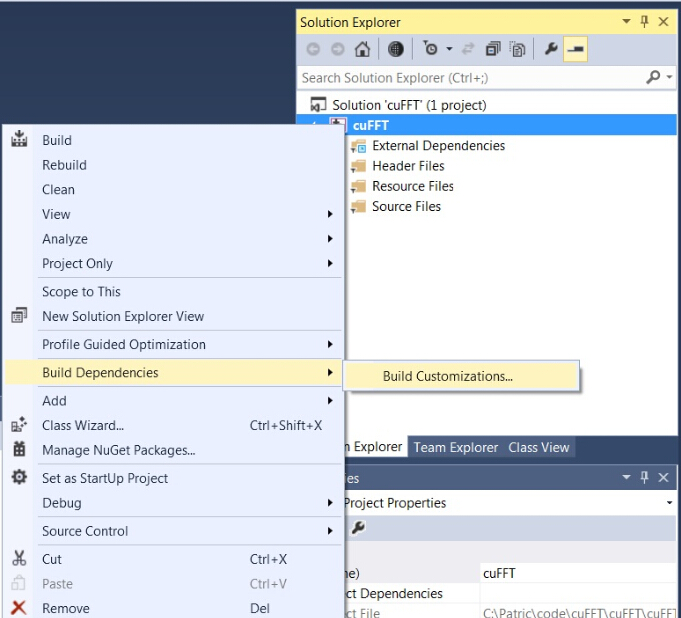
- (right click on project) -> Build dependecies -> Build Customizations -> set check on CUDA 8.0 or what version you have - for example as here: http://devblogs.nvidia.com/parallelforall/wp-content/uploads/2015/01/VS2013-R-5.jpg
- add to project all .c & .cu files from \src
- (right click on project) -> properties -> Linker -> General -> Additional Library Directories, put here:
C:\opencv_2.4.9\opencv\build\x64\vc12\lib;$(CUDA_PATH)lib\$(PlatformName);$(cudnn)\lib\x64;%(AdditionalLibraryDirectories)
- (right click on project) -> properties -> Linker -> Input -> Additional dependecies, put here:
..\..\3rdparty\lib\x64\pthreadVC2.lib;cublas.lib;curand.lib;cudart.lib;cudnn.lib;%(AdditionalDependencies)
- (right click on project) -> properties -> C/C++ -> Preprocessor -> Preprocessor Definitions
open file: \src\yolo.c and change 3 lines to your OpenCV-version - 249 (for 2.4.9), 2413 (for 2.4.13), ... :
#pragma comment(lib, "opencv_core249.lib")#pragma comment(lib, "opencv_imgproc249.lib")#pragma comment(lib, "opencv_highgui249.lib")OPENCV;_TIMESPEC_DEFINED;_CRT_SECURE_NO_WARNINGS;GPU;WIN32;NDEBUG;_CONSOLE;_LIB;%(PreprocessorDefinitions)
- compile to .exe (X64 & Release) and put .dll-s near with .exe:
pthreadVC2.dll, pthreadGC2.dll from \3rdparty\dll\x64
cusolver64_80.dll, curand64_80.dll, cudart64_80.dll, cublas64_80.dll - 80 for CUDA 8.0 or your version, from C:\Program Files\NVIDIA GPU Computing Toolkit\CUDA\v8.0\bin
Download pre-trained weights for the convolutional layers (76 MB): http://pjreddie.com/media/files/darknet19_448.conv.23 and put to the directory build\darknet\x64
Download The Pascal VOC Data and unpack it to directory build\darknet\x64\data\voc: http://pjreddie.com/projects/pascal-voc-dataset-mirror/ will be created file voc_label.py and \VOCdevkit\ dir
Download and install Python for Windows: https://www.python.org/ftp/python/3.5.2/python-3.5.2-amd64.exe
Run command: python build\darknet\x64\data\voc\voc_label.py (to generate files: 2007_test.txt, 2007_train.txt, 2007_val.txt, 2012_train.txt, 2012_val.txt)
Run command: type 2007_train.txt 2007_val.txt 2012_*.txt > train.txt
Start training by using train_voc.cmd or by using the command line: darknet.exe detector train data/voc.data yolo-voc.cfg darknet19_448.conv.23
If required change pathes in the file build\darknet\x64\data\voc.data
More information about training by the link: http://pjreddie.com/darknet/yolo/#train-voc
Train it first on 1 GPU for like 1000 iterations: darknet.exe detector train data/voc.data yolo-voc.cfg darknet19_448.conv.23
Then stop and by using partially-trained model /backup/yolo-voc_1000.weights run training with multigpu (up to 4 GPUs): darknet.exe detector train data/voc.data yolo-voc.cfg yolo-voc_1000.weights -gpus 0,1,2,3
https://groups.google.com/d/msg/darknet/NbJqonJBTSY/Te5PfIpuCAAJ
yolo-obj.cfg with the same content as in yolo-voc.cfg (or copy yolo-voc.cfg to yolo-obj.cfg) and:classes=20 to your number of objectsfilters=425 to filters=(classes + 5)*5 (generally this depends on the num and coords, i.e. equal to (classes + coords + 1)*num)For example, for 2 objects, your file yolo-obj.cfg should differ from yolo-voc.cfg in such lines:
```
[convolutional]
filters=35
[region]
classes=2
```
Create file obj.names in the directory build\darknet\x64\data\, with objects names - each in new line
Create file obj.data in the directory build\darknet\x64\data\, containing (where classes = number of objects):
classes= 2 train = train.txt valid = test.txt names = obj.names backup = backup/
Put image-files (.jpg) of your objects in the directory build\darknet\x64\data\obj\
Create .txt-file for each .jpg-image-file - with the same name, but with .txt-extension, and put to file: object number and object coordinates on this image, for each object in new line: <object-class> <x> <y> <width> <height>
Where:
* <object-class> - integer number of object from 0 to (classes-1)
* <x> <y> <width> <height> - float values relative to width and height of image, it can be equal from 0.0 to 1.0
* atention: <x> <y> - are center of rectangle (are not top-left corner)
For example for img1.jpg you should create img1.txt containing:
1 0.716797 0.395833 0.216406 0.147222 0 0.687109 0.379167 0.255469 0.158333 1 0.420312 0.395833 0.140625 0.166667
train.txt in directory build\darknet\x64\data\, with filenames of your images, each filename in new line, with path relative to darknet.exe, for example containing: data/obj/img1.jpg data/obj/img2.jpg data/obj/img3.jpg
Download pre-trained weights for the convolutional layers (76 MB): http://pjreddie.com/media/files/darknet19_448.conv.23 and put to the directory build\darknet\x64
Start training by using the command line: darknet.exe detector train data/obj.data yolo-obj.cfg darknet19_448.conv.23
After training is complete - get result yolo-obj_final.weights from path build\darknet\x64\backup\
yolo-obj_12000.weights to detection.Example of custom object detection: darknet.exe detector test data/obj.data yolo-obj.cfg yolo-obj_3000.weights
 |
 |
|---|
Here you can find repository with GUI-software for marking bounded boxes of objects and generating annotation files for Yolo v2: https://github.com/AlexeyAB/Yolo_mark
With example of: train.txt, obj.names, obj.data, yolo-obj.cfg, air1-6.txt, bird1-4.txt for 2 classes of objects (air, bird) and train_obj.cmd with example how to train this image-set with Yolo v2